Lattice Genesis
Even the favicon is physics
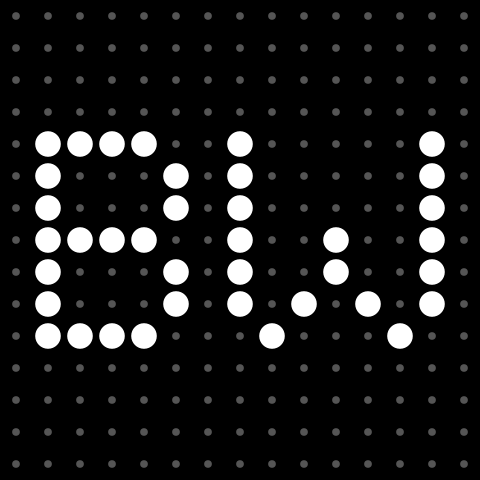
The BW monogram is a programmatically constructed two-dimensional square Bravais lattice, governed by the equation
Here is the uniform lattice constant, and are integer lattice indices.
Every atomic site occupies a mathematically precise position, with a constant nearest-neighbour separation.
The initials emerge exclusively through selective highlighting of substitutional sites, without introducing any positional displacement in the idealised lattice.
The site occupancy can be represented by a binary function.
Here denotes the subset of lattice sites selected to form the initials BW.
Inspired by atomic manipulation, scanning tunnelling microscopy (STM) and substitutional defect engineering, the design illustrates how information can be encoded within an idealised crystalline structure.
The favicon was generated entirely through Python and rendered as a scalable vector graphic (SVG). The image is a mathematical representation. No experimental STM micrograph was used.
Magnetic Memory
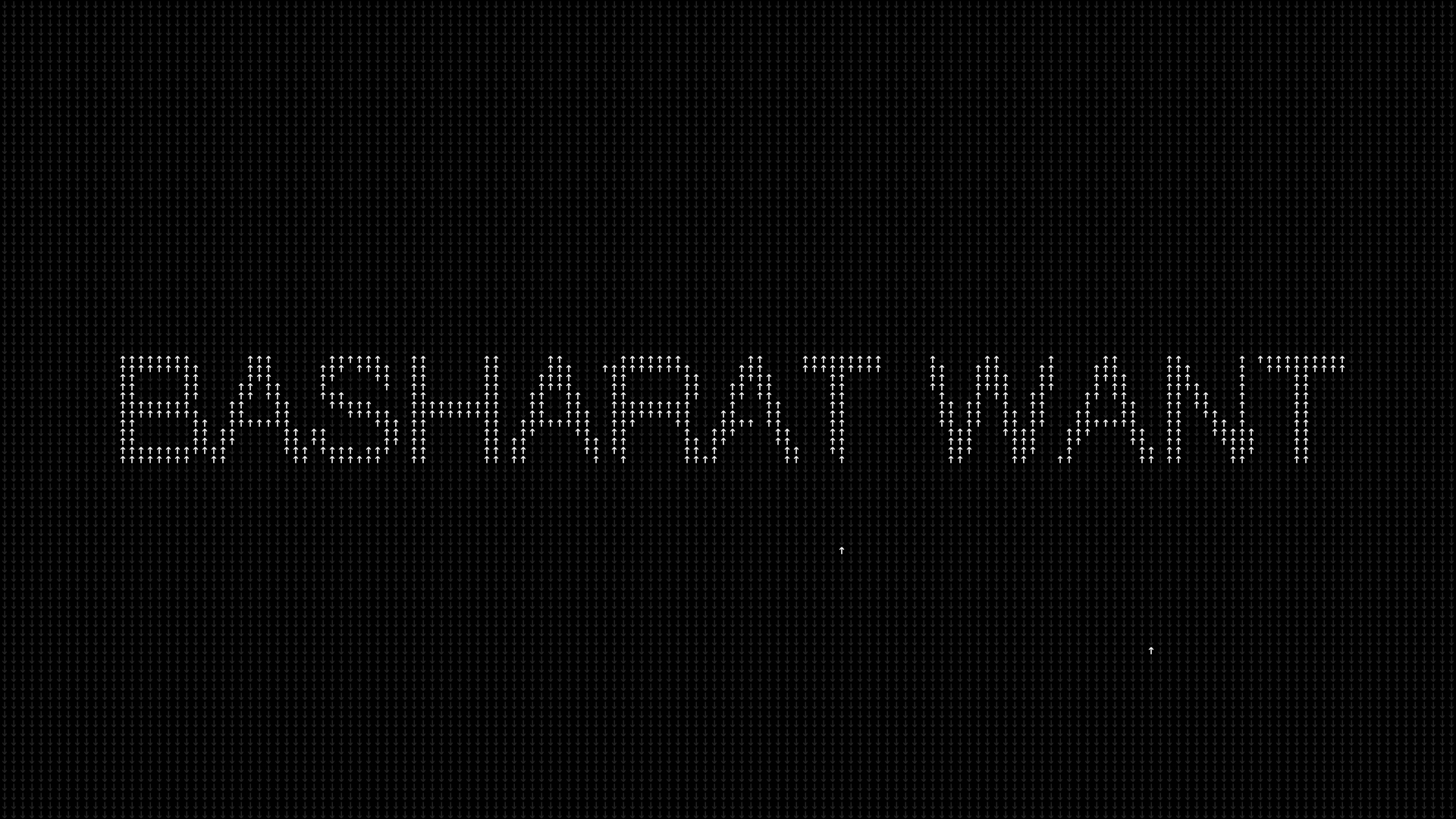
Magnetic Memory visualises magnetic domain reversal through a spatially biased two-dimensional Ising model implemented in Python. The simulation places 14,400 magnetic moments on a periodic square lattice of 160 × 90 sites. Each moment occupies a fixed site and has one of two spin orientations.
The physics behind Magnetic Memory
A modified Ising Hamiltonian governs the magnetic interactions.
- is the ferromagnetic exchange coupling.
- is the externally applied magnetic field.
- is the site-dependent local magnetic bias.
- is the orientation of an individual spin.
- denotes nearest-neighbour interactions.
The local magnetic bias encodes the name BASHARAT WANT in the spin lattice.
denotes the subset of sites that form the inscription.
Magnetic domain reversal
The system begins in an idealised state of negative magnetic saturation.
As the external field increases, individual spins reverse stochastically under the Metropolis Monte Carlo algorithm. The energy change for reversing spin is given below, with denoting its nearest neighbours.
The Metropolis criterion gives the probability of accepting a spin reversal.
is the Boltzmann constant and is the absolute temperature. The normalised magnetisation is the mean spin over the sites.
The site-dependent bias favours opposing spin orientations inside and outside the inscription, so the name emerges through magnetic reversal. Each visible arrow represents one simulated moment. The spin configuration and global visual contrast settings determine its direction and displayed intensity.
Preservation of lattice geometry
Every magnetic moment remains at a fixed lattice position.
The lattice constant stays uniform, and positional displacement is zero.
Only the spin orientations evolve during the simulation.
Magnetic Memory illustrates spin reversal in an idealised Ising model under a partial field sweep. A patterned magnetic bias encodes the inscription, and playback time represents simulation progress without calibration to physical time.
Entropy — Order Lost
Even the error page obeys physics
The 404 page visualises Brownian diffusion and the gradual dispersal of spatial information. At the start, 12,000 particles form the number 404. Their stochastic motion gradually dissolves the inscription.
Each particle follows a two-dimensional Brownian diffusion process.
is the time-dependent diffusion coefficient, and is a two-dimensional Wiener process.
The corresponding probability density evolves according to the diffusion equation.
As the particles disperse, their coarse-grained spatial entropy generally increases.
is the probability of finding a particle in spatial region . The particles redistribute while their total number stays fixed, making the information in the initial arrangement progressively less distinguishable.
Generated in Python through numerical computation, the animation represents idealised stochastic diffusion. Its entropy measure describes the coarse-grained spatial distribution alone. Complete thermodynamic entropy lies outside the scope of the model.
Replay restores the initial conditions by resetting the computation. The second law of thermodynamics is unaffected.
The website begins with order, concludes with magnetic ordering, and when something goes wrong, entropy wins.